Saturday, December 24, 2005

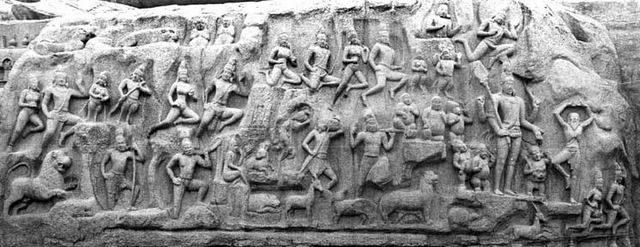
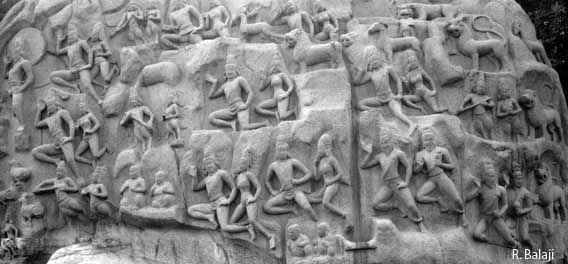
A full frame view of the mural, scanned from a transparency. Posted by Picasa
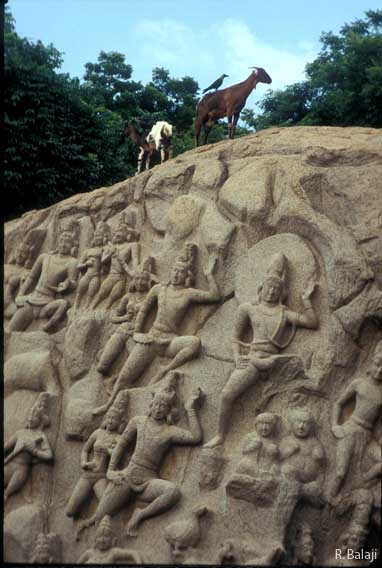
Live animals form an extension of the mural. Posted by Picasa
A section of the mural with modern day additions. Posted by Picasa
This section holds the main characters from which this mural takes its name, Arjuna's penance. The bearded and skeleton-thin character standing on one leg to the right is Arjuna, to his left carrying the trident is the four-armed shiva blessing him. Shiva is surrounded by his `ganas' gods and goddesses. part human and part animal characters, and the more earthly animals and hunters.  Posted by Picasa
This lot is directly above the elephants. Posted by Picasa
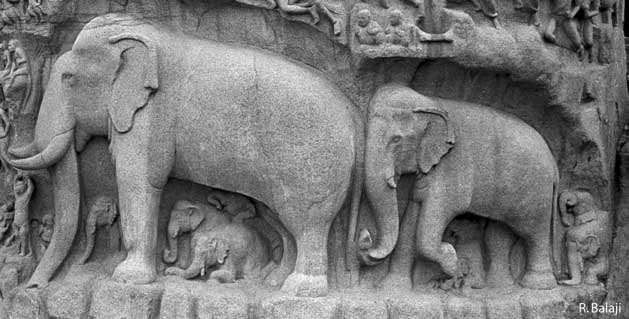
The herd of elephants, the most prominent of the figures in the mural - I can count 10 in this herd. Posted by Picasa

Saturday, December 17, 2005

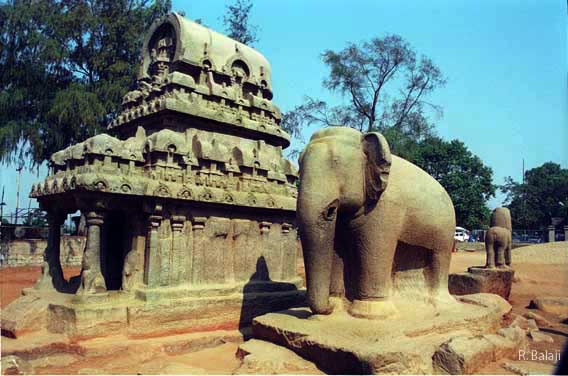
The elephant in the five ratha complex at Mamallapuram, the monument by the Pallavas. Behind it is the Nakula-Sahadeva ratha. (By mistake I have reversed the order in which I originally planned to post this series of pic. Please scroll down and start from the pic that shows the whole complex for the more detailed caption,) Posted by Picasa
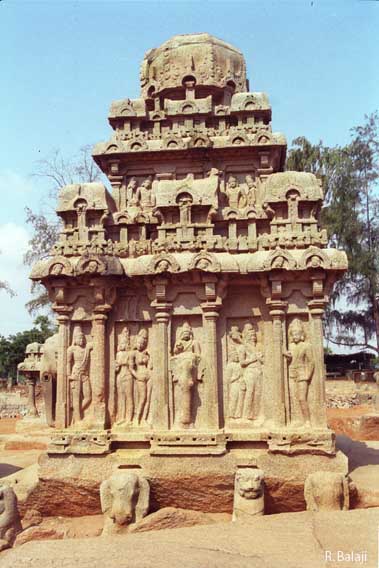
Some details - the figure in the centre is Indra, the king of the gods on his elephant, airavata. Posted by Picasa
A closer view of the Arjuna ratha. Posted by Picasa
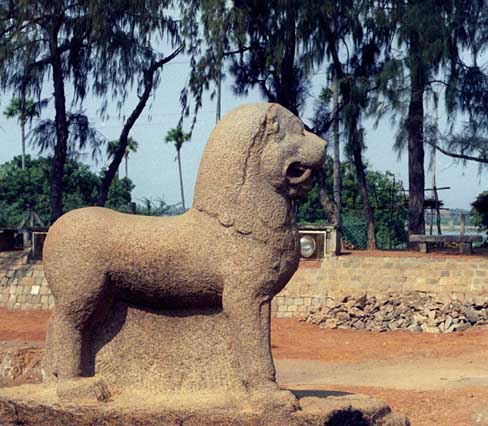
The lion. Posted by Picasa
In black and white. Posted by Picasa
A different angle of view of the five rathas. Posted by Picasa
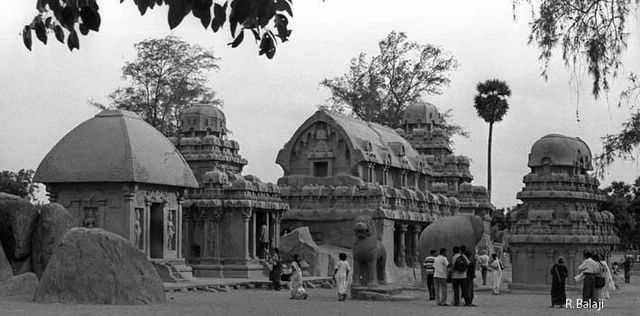
The same in colour. This is the second set of the series of pics I plan to post on Mamallapuram, the Pallava monuments, about 50 km south of Chennai. According to a publication of the Archaeological Survey of India, by C. Sivamurthy, these were sculpted during the reign of Narasimhavarman I and are the earliest monuments of their kind in India. While the five rathas (chariots) are named after the five Pandavas the heroes of the Mahabaratha and Draupadi, their wife, there is no historical significance says the author. (Also note of the five pandavas the ratha on the extreme right is named after the twins Nakula and Sahadeva; the one on the left is Draupadi ratha, next Arjuna ratha, then Bhima and the furthest one Dharamaraja ratha.) Posted by Picasa
The five rathas - temples carved out of a single rock. You can see the height of the structures increases from the smallest one to the left to the tallest one at the end - this indicates the slope of the hillock that was carved out into these structures. Posted by Picasa

Sunday, December 11, 2005

Mamallapuram

I am posting a series of pics on the Pallava temples and sculptures at Mahabalipuram, about 50 km south of Chennai on the east coast. Today it is a small town with tourism as its mainstay.
Once, about 2,000 years ago it was a major seaport.
Some details from a publication by the Archaeolgical Survey of India, which says it has been famous as a sea port and has been mentioned in the Periplus of the Erythraen Sea written by an unknown Greek navigator in the first century -
“The modern name Mahabalipuram is derived from Mamallapuram, `the city of Mamalla,’ a title of Narasimhavarma I (630 – 670), a great Pallava ruler of the seventh century, who was responsible for most of the rock-cut teples and carvings at the place.”
“The Pallavas –
The monuments at Mahabalipuram owe their origin to the Pallava rulers of south India, who came into existence in the third – fourth century and ruled from their capital at Kanchi.”
The book categorises the monuments into four groups. They are: monoliths – temples cut out of solid rock; caves – excavated from the hills; temples – built up masonry temples (with richly carved sculptures); and sculptured scenes carved on the hill sides.
So this series of pics over the next few weeks will follow this format. The first will be of the Shore Temple – the third in the above category – the masonry temple.

A Note: The East Coast Road leading to Mahabalipuram from Chennai makes it a great drive – if you drive cautiously and allow for the mad driving of some of the maniacs who get on to that road. It is important that people choose a pleasant day to get there. During summer it can get quite hot and humid.
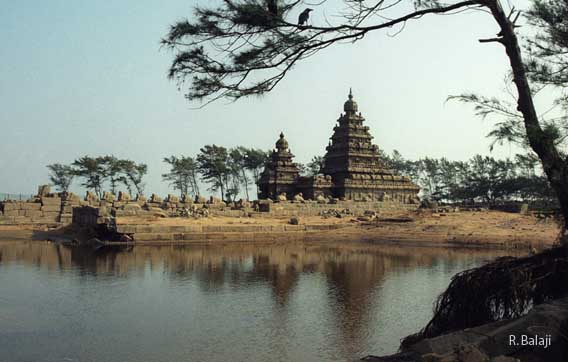
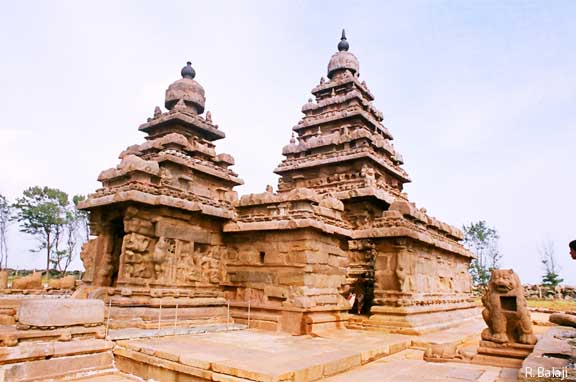
The Shore Temples at Mahabalipuram. These are temples dedicated to Shiva. The taller gopuram actually faces east - towards the sea - and the smaller one in the opposite direction. Posted by Picasa

Saturday, December 10, 2005

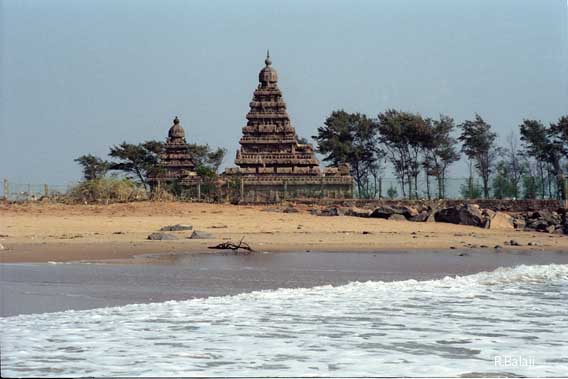
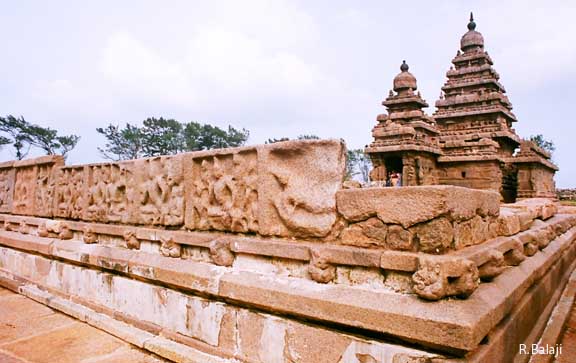
Easy to see why they are called the shore temples. But the sea has also proved the bane of these structures which are severly eroded by centuries of sea breeze and wave action. Much of the details of the sculptures are lost but the Archaeological Survey of India has done some preservation work. Posted by Picasa
Another view of the shore temples. Posted by Picasa
The entrance. Posted by Picasa
The Nandis on the walls surrounding the shore temple. Posted by Picasa
The surrounding walls. Posted by Picasa
A view of the richly carved shore temples. Posted by Picasa
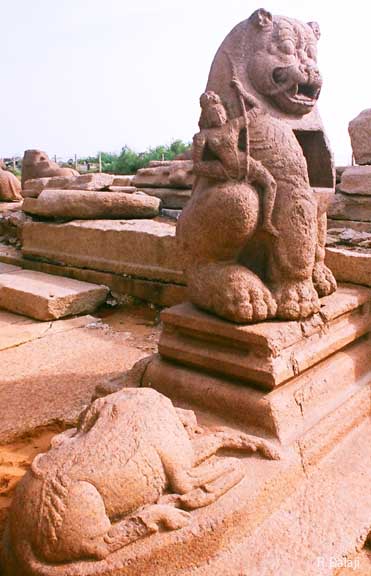
A sculpture of goddess Durga on a lion. That small window cut in the lion's chest has a small carving of the goddess. Posted by Picasa
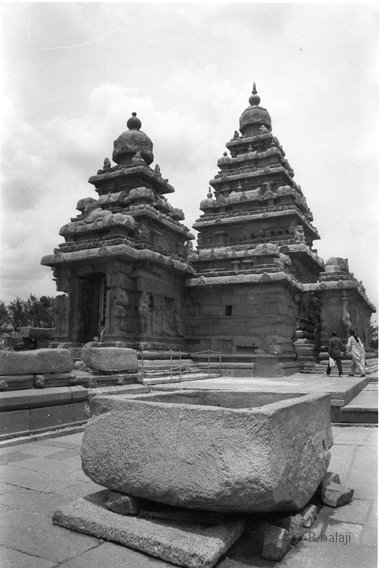
In black and white. Posted by Picasa
This picture was taken a few years back. I just love the lighting in this pic. Apart from that another reason - vintage camera lovers may be interested - is that it was taken with a Mamiya Universal Press camera. It takes 120 mm film and each negative measures 6 cm X 9 cm.
It is a big and impressive looking camera. That caused a bit of problem - now filming with a movie camera is not allowed at this place and the guards there would just not believe that the Mamiya Press was a still camera. I first had to convince them and even then a guard followed me around while I took pics with that camera until he was convinced that I was taking individual shots.
Posted by Picasa

Thursday, December 01, 2005

A couple of Sambhar cross a track at Ranthambore Tiger Reserve, Rajasthan. Posted by Picasa